

Years ago, before we had children, my husband and I were sitting at a bar talking about a landscaping business he wanted to start. Somewhere in that conversation, I picked up a cocktail napkin and started sketching a logo. We came up with the name Mountain Spruce Landscaping, which eventually became our first design-build landscaping business.
Oh, how much we've learned about entrepreneurship since then. Everything from the late nights and unexpected setbacks to the incredible wins and the satisfaction of watching our hard work become something that provides for our family. Building a business together has tested our patience, challenged our assumptions, and taught us a few lessons we probably couldn't have learned any other way.
Landscaping may have been my husband's primary passion, but I loved being part of building something. I especially enjoyed the creative work that came with it. I built our website, developed our branding, designed print marketing materials, and contributed to the efforts we put into growing the business. At the time, I didn't think much about what that little sketch might mean for my own future. We were simply two people talking about an idea, trying to figure out what it might look like in the real world.
Looking back, I think that's where I started discovering how much I enjoyed helping a business take shape.
The Things I've Always Loved
I've always loved learning, especially when I can take something I've researched and actually use it. I can spend hours looking into different techniques, experimenting with software, exploring an unfamiliar art medium, or researching how someone accomplished something I find interesting. Sometimes that curiosity leads to a finished project. Other times, I end up with a notebook full of ideas and a new collection of things I want to try.
I'm naturally drawn to improvement. I want to understand why something works, what could make it better, and whether there's another approach worth exploring.
That curiosity has followed me through several different careers, although I didn't always recognize the connection between them. I've taught art, worked on corporate marketing teams, and helped build our family businesses. The responsibilities were different, but the parts I enjoyed most were surprisingly similar. I liked communicating ideas, solving problems creatively, and seeing someone take what they'd learned and use it to accomplish something.
I also discovered that I genuinely enjoy helping other people succeed. There's something rewarding about knowing your work contributed to another person's progress, especially when you can see what they've been able to build from it.
Learning Marketing at IBM
One of the most influential experiences of my career was working in marketing at IBM, where I started as a contractor before eventually being hired into a full-time position with IBM Watson AI.
I had opportunities to work alongside experienced professionals in campaign management, performance marketing, social media, executive communications, events, and design. I was fascinated by how much went into creating and managing campaigns at that scale. There were specialists in areas I hadn't even realized existed, and I wanted to learn from as many of them as I could.
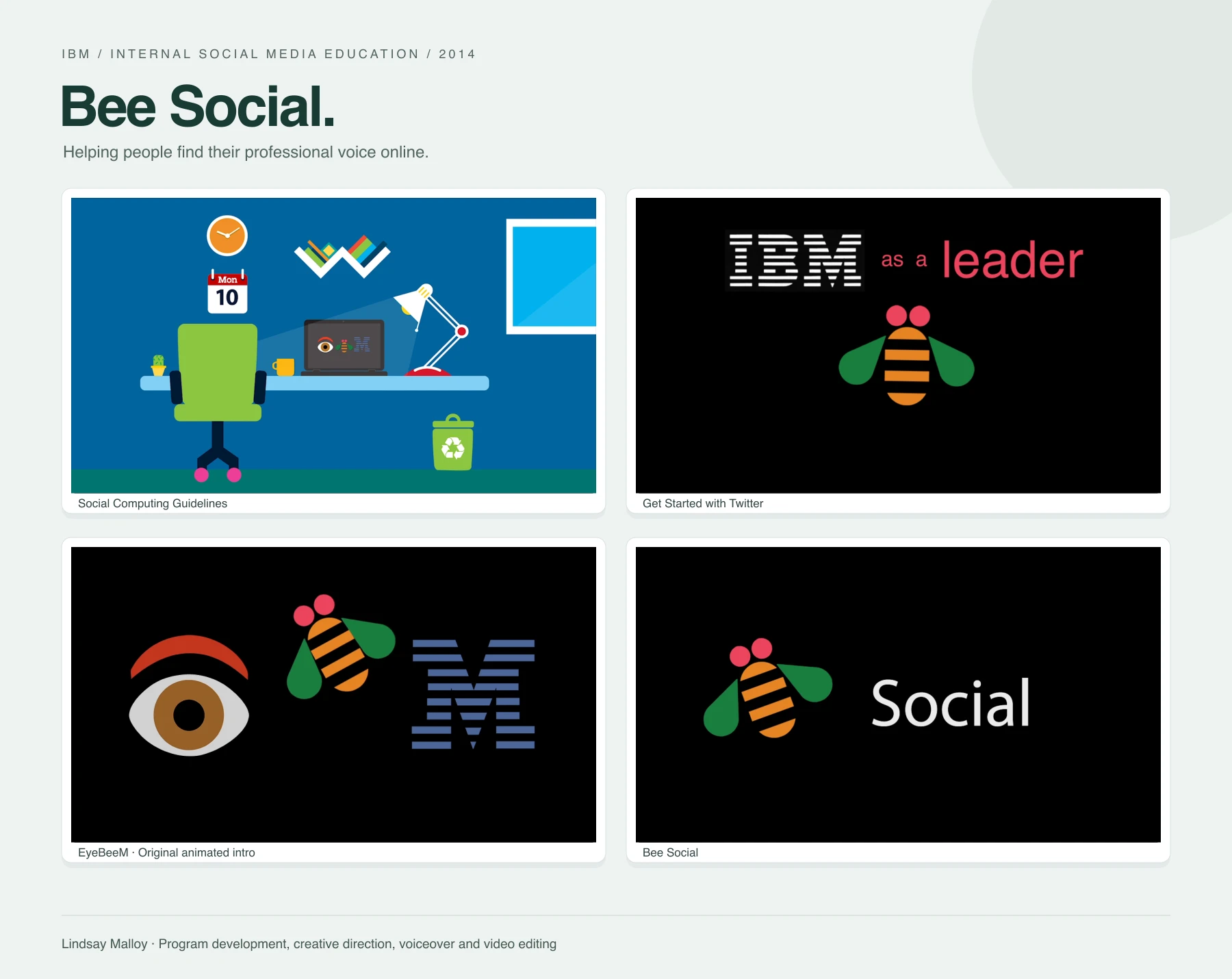
Some of my favorite work was educational. I created and named an internal initiative called Bee Social, a play on the bee in Paul Rand's famous Eye-Bee-M design. I developed the program and provided creative direction to a designer as we produced training videos to help IBM employees develop their professional social media presence and share their expertise. I handled the voiceovers, video editing, internal communications, and other production elements, while she contributed visual design. I loved building something that could teach people how to communicate more effectively.
I also supported executive social media communications, including ghostwriting content and publishing on behalf of marketing leadership. Those experiences taught me to think carefully about audience, tone, and the responsibility of communicating in someone else's voice.
Later, working with IBM Watson AI gave me opportunities to participate in developer marketing campaigns, digital events, webinars, and email communications. One of my favorite experiences was contributing to the first ever Watson Developer Conference in San Francisco.
I remember being part of the early conversations about who we wanted to reach and what kind of experience we wanted to create for them. Those discussions eventually became a two-day event designed to bring developers together for hackathon challenges, live coding tutorials, hands-on labs, and opportunities to engage directly with IBM experts.
Watching an idea develop from those initial conversations into a real event was fascinating. We weren't simply trying to fill a room. We were thinking about who belonged in that room, what would interest them, and how we could create an experience worth attending. Everything from the promotional materials and email communications to the registration process had a role in making that happen.
It taught me something I've carried with me ever since: before you start creating the marketing, you need to understand who you're trying to reach.
The data interested me just as much as the design. I could watch how people responded to different messages and learn from those results. A beautiful design might catch someone's attention, but good marketing required understanding what happened afterward. Did people register? Did they engage? Did they take the next step? What could we change to make the experience better?
That combination of creativity, communication, and continuous improvement was exactly the kind of work I enjoyed.
Finding My Way Back to the Classroom
Eventually, continuing my career at IBM would have required relocating to New York. My husband and I were building our lives in Colorado Springs, his career was here, and we were planning our future together. Moving wasn't the direction I wanted for us, so I made the decision to stay.
I returned to teaching third grade, a profession that had already been part of my life before IBM. Over the years, my path between teaching, raising a family, and helping build our businesses wasn't always straightforward. I spent time at home with our children, supported the development of our landscaping business, and eventually returned to the classroom again.
Those years brought plenty of changes, both personally and professionally. Starting a business while raising a young family isn't for the faint of heart. Neither is building a life together while navigating all the uncertainties that come with it. We've learned that growth isn't always a straight line, and sometimes the most important lessons come from having to adjust when things don't go according to plan.
Through it all, I kept returning to the things I enjoyed: learning, creating, communicating, and helping people improve.
Teaching gave me opportunities to develop another side of my creativity. I designed lessons, created demonstrations, experimented with different ways of presenting information, and tried to make learning interesting for students who came into the classroom with very different abilities and motivations.
I loved the creative freedom of building an original lesson. There were times when an idea came together particularly well, and watching students engage with it reminded me why I'd chosen education in the first place.
Looking back, I can see how much teaching and marketing have in common. Both require understanding an audience, communicating a message, finding ways to create interest, and recognizing when an approach needs to change. In the classroom, I was constantly making creative decisions about how to help someone understand or experience something new.
But as the years went on, I began questioning whether the classroom was still the right place for me to do that work.
There are challenges in public education that extend far beyond any individual teacher or school, and I don't want this story to become a criticism of the profession. Teaching has given me experiences and skills that I value. Still, I was increasingly aware of how much energy I was investing and how little room I felt I had to direct that energy toward the kind of growth I wanted in my own life.
I missed having more ownership over the work I created. I missed being able to follow an idea, test it, improve it, and decide what came next. Most of all, I wanted to feel that I was growing, too.
My students' growth was always the goal. I loved finding ways to meet their interests and needs, even when that meant teaching something outside my own areas of expertise. But I wasn't always in control of what I could teach or how I could teach it. From scripted instruction early in my career to curriculum standards and course requirements later on, there were times when the room to experiment creatively felt very small. I wanted to keep helping students learn while also having more freedom to explore, create, and grow in my own work.
I started thinking about what professional growth would look like if I stayed in education. Moving into administration wasn't something I wanted to pursue because it would take me further away from the hands-on creative work I enjoyed. Other paths toward salary advancement often involved additional education, credentials, or years of service.
Those are worthwhile paths for many educators, but they weren't the direction I wanted for myself.
I'd experienced a different kind of professional growth during my years at IBM, where I could develop new skills, take on different responsibilities, and learn directly from people working across the marketing industry. I'd also watched my husband navigate the opportunities and challenges of growing a business.
I wanted more room to direct my own development, both professionally and financially, without stepping away from the creative work I loved.
The Idea That Kept Coming Back
I remember one evening scrolling through social media, probably trying to distract myself from the thought of returning to the classroom the next morning. I was looking at different businesses, creative projects, and possibilities for something I could build myself.
This wasn't a new habit. I've spent years collecting ideas and researching things that interest me, occasionally taking the next step and trying to sell something I'd made. Anyone want to buy a hand-filled glitter cup? Yes? Okay, fast-flow or suspended glitter?
Some of those experiments worked better than others, and I learned something from nearly all of them. But I was getting tired of having so many ideas without giving any one of them enough time to develop.
I started thinking seriously about the kind of work I wanted to spend my days doing. I wanted to keep learning and making art, but I also wanted to help people solve problems and improve what they were already building.
Business owners seemed like a natural fit. I remembered how much I enjoyed working with startup-minded teams, experienced marketers, and people in the technology industry who shared my enthusiasm for experimenting, learning, and finding opportunities to grow.
That was my kind of environment.
I don't expect anyone to have all the answers. I certainly don't. What matters to me is the willingness to keep learning, make thoughtful changes, and see where those changes lead.
I wanted to work with people who wanted to grow, and I wanted to create an opportunity for myself to do the same, at a pace I could help determine.
Because as much as I value education, I was ready for a professional environment where I could have more influence over what I learned, what I created, and how quickly I moved forward.
The Business Experience I Already Had
While all these ideas were taking shape, I was also continuing to help with our family businesses.
Mountain Spruce Landscaping had evolved over the years, briefly operating as Landscape IQ as the business changed direction. Eventually, we stepped away from design-build landscaping and focused fully on Lawn IQ.
Through those transitions, I'd been involved in creative and marketing work that helped shape how the businesses presented themselves. I designed materials, developed branding, and worked on communications intended to help customers understand what we offered and why they might choose us.
I knew what it was like to be part of a small business where decisions needed to be practical and resources weren't unlimited. We couldn't simply hire a separate specialist every time we needed something created. Being able to contribute my marketing and design skills gave me a way to support the business while continuing to do work I enjoyed.
It also helped me recognize something important about my professional experience.
I'd learned how marketing worked within a large organization, where campaigns involved teams of specialists, structured processes, and detailed performance measurement. I also understood what it felt like to build a local business where the owner was responsible for countless decisions, often without the time or resources available to a larger company.
I wanted to bring those perspectives together. Not to make a small business behave like a corporation, but to apply useful marketing principles in ways that fit the people and businesses I was working with.
(Differentiated instruction, anyone? My fellow educator nerds know what I'm talking about.)
Why Wicked Plumeria?
The more I thought about it, the more I realized that I didn't want to choose between being an artist, a marketer, or an educator. I wanted to find a way to combine those parts of myself.
Wicked Plumeria is the creative marketing studio I'm building around that idea. The purpose is to help businesses grow through thoughtful creative work, whether that's one focused project or an ongoing partnership.
I don't want the studio to become a place where the goal is simply to produce more content. I want to understand what a business is trying to accomplish and explore creative ways to help it get there. (Social media is not the end all, be all, y’all!)
Sometimes the solution might be a campaign or a stronger brand presence. Other times it could be a printed piece that customers actually want to keep, a memorable community interaction, a better customer experience, or something unexpected that helps a business stand apart.
I'm particularly interested in the ideas that require us to think beyond the usual approaches.
And I still want to make art. Painting, drawing, designing, and experimenting with materials are things I enjoy for their own sake, and I believe continuing to develop as an artist will make me a stronger creative director.
Over time, I'd love to build a studio where other artists can contribute their skills and where young people have opportunities to discover how creative work applies outside the classroom. That's a long-term vision. For now, I'm beginning with what I know, what I can make, and the experience I've gathered along the way.
Building a Life Around Growth
This decision is about more than my career.
I want to build a life that allows me to keep growing creatively, professionally, financially, and personally. I want to contribute to our family's future, have more flexibility with my children, and create room for the relationships and experiences that matter to me.
My own well-being has to be part of that picture. I've spent enough time putting energy into responsibilities while feeling like I had little left for the things I wanted to build.
I want my children to see what lifelong learning looks like outside of a classroom. I want them to know that it's possible to change direction, pursue an idea, and keep developing your abilities throughout your life. There will be mistakes, changes, and plenty of things that don't work as expected, but I think there's value in showing them that growth requires participation.
You have to be willing to try.
I'm not leaving teaching because I've stopped believing in education. I'm choosing to take the things I've learned from education and apply them in a different way, one that better supports the future I want to build for myself and my family.
Where I'm Starting
Wicked Plumeria is still at the beginning, and I have a lot to learn about running a creative studio of my own.
I have ideas for original artwork, commissions, marketing projects, collaborations, and eventually opportunities for other artists. Some of those plans are years away, while others are already taking shape. I expect the direction will evolve as I gain experience, work with clients, and figure out what makes the most sense for the business.
I'll be sharing that process here: the work I create, the decisions behind it, the things I'm learning, and the projects that help me become better at what I do.
I want this studio to be a place where creativity leads to something useful, where learning is part of the work every step of the way, and where the people involved genuinely want to grow.
Years ago, I helped sketch the beginning of my husband's business on a cocktail napkin. Through that experience and everything that followed, I found parts of my own professional direction.
Now I'm bringing those pieces together to build something of my own.
Welcome to Wicked Plumeria.
— Lindsay Malloy